Think you can’t avoid a stomach virus after being exposed? Think again! I did it–and I think you can, too!
The month of March is always full of surprises.
Where I live in North Carolina, one day it’s 75 degrees F, and the next day it’s sleeting. It’s the month when you leave your home in the morning wearing a coat and scarf and are donning a pair of flip flops by the afternoon.
It’s also the season when you fool yourself into thinking that you’ve made it all winter without getting sick. You’ve avoided the flu, colds and the horrible, no-good stomach virus.
It hit the girls first–one-by-one they began throwing up.
Then, in the middle of the night, it overtook my poor husband.
All night long, I listened to the bug biting my family. I cleaned up their messes and soothed them as best I could, and I prayed I wouldn’t get sick as well.
But I knew it was coming. I just knew it! How could I avoid such a highly-contagious illness when every single person in my home was affected by it?
But I did! Oh, I did!
And not only that–but I used natural means to avoid a stomach virus!
My plan of attack was simple: I did not want to get sick! With sheer determination, I scoured my natural medicine arsenal.
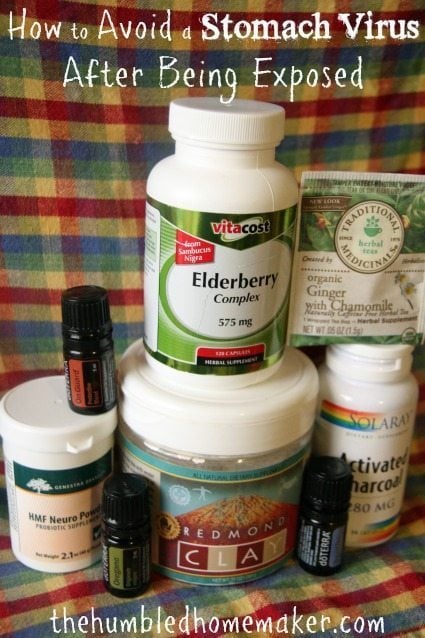
Here is what I came up with that helped me avoid a stomach virus after being exposed:
A few days before the stomach virus hit our house, I had felt the very first signs of a cold (my first in two years!). My first symptom of a cold is usually a scratchy throat. Wanting to stave off the cold before it really started, I began loading up on elderberry, vitamin C, echinacea and garlic.
Without knowing it, I was strengthening my immune system to fight off another bug!
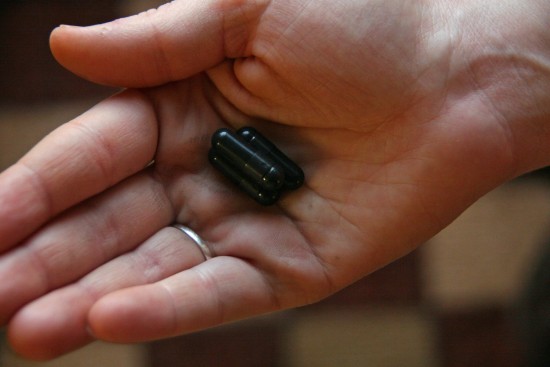
Thankfully, having heard that activated charcoal can work wonders for tummy ailments, I already had this stashed away in our natural medicine cabinet. But because our family hadn’t been ill for the past two years, I had never really used it!
Hands down, if you do not heed anything else in this post, please, please, please stock your natural medicine cabinet with activated charcoal!
In a nutshell, activated charcoal adsorbs most toxins in your body before they can harm you (source). Some emergency rooms even give activated charcoal to patients with food poisoning!
I was a bit skeptical to take it at first because I assumed this was a stomach virus, and I had heard that activated charcoal only works with stomach problems caused by bacteria.
But then I found this post by my friend Kimberly at The Nourishing Gourmet. (And yes, I actually found it in a Google search in the middle of the night!) In the post, Kimberly recounts how her family beat the stomach virus with the use of activated charcoal as well!
I took Kimberly’s advice, and I am so glad I did. I truly feel that the activated charcoal took care of the virus that was most likely already inside of my body.
I took two capsules with water every few hours. Read Kimberly’s post for more details on dosing. Also, keep in mind that the activated charcoal may also adsorb all the good nutrients in your body as well, so do not take it at the same time as your other supplements.
I continued to take 1-2 capsules of activated charcoal for a few days after the stomach virus left our house.
Note: If you child is actively throwing up, it may not be a good idea to give them charcoal unless there is a bucket near by. One of our kids threw up charcoal all over the carpet. Talk about a mess to clean up.
3. Digestion Essential Oil Blend
Essential oils are a big part of my family’s natural medicine cabinet. Many bloggers love them so much that they decide to sell them. I love them so much that I will sing their praises without selling them–because I hate selling things! Ha!
I rubbed a couple drops of the oil blend, diluted with a carrier oil, on my stomach every few hours while my household had the stomach virus.
4. Immune-Boosting Essential Oil Blend
When my family became ill, I did not hesitate to begin rubbing a diluted immune-boosting oil blend on my feet and the feet of my family members. I also added it to a diffuser where my husband, who was the most ill, was sleeping.
This happened to be the only ginger tea I had on hand (and I was completely out of ginger, so I couldn’t make my own!). I drank it the morning after the long night of my family’s illness, and it definitely had a nice calming effect!
6. A Strong Probiotic
I typically give my girls the Garden of Life Raw probiotic, which I get from Vitacost.com, but my husband and I usually take a cheaper Vitacost brand probiotic for our daily dose. However, I had recently purchased a super probiotic supplement from my girls’ integrative pediatrician–HMF Neuro Powder. I will say this stuff is PRICEY. I had it on hand for such a time as this.
When a stomach virus hits, I believe it’s the time to pull out the best of the best probiotics.
In addition to taking the probiotic powder, I also ate some coconut milk yogurt, which we also happened to have on hand that day.
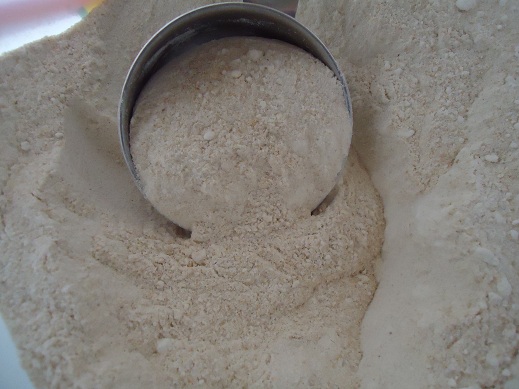
Redmond Clay is helpful for an assortment of ailments, including stomach issues.
I did not take much of this, as I felt really confident in the activated charcoal, but I did take a little bit.
It is supposed to adsorb the toxins and flush them out of your system as well. I just didn’t feel like I needed both the activated charcoal and the clay at the same time.
This is the first winter we have owned an air purifier, and you better believe I had it running during this illness! In fact, I moved it from room to room.
Interestingly enough? The air purifier we use turns red when there are contaminants in the air. It turned the reddest when I put my natural cleaners aside and pulled out the Lysol! Now if that doesn’t tell you something about the toxins in conventional cleaners…
It’s been two and a half weeks since the stomach virus hit our house, and I never got it!
This was a new one to me after I wrote the original post. Someone at church told us about it, and it’s been our go-to ever since. Supposedly, grape juice coats the stomach and helps you avoid the stomach virus!
This is one of the easiest to get on the spur of the moment (although we make sure to always keep the other supplies on hand!). I dissolve activated charcoalin grape juice for my kids. This has helped us so much!
Note: Again, if you child is actively throwing up, I would not recommend giving them grape juice. Dark purple spots do not look good on carpet (ask me how I know.)
What are your tips for how to avoid a stomach virus after being exposed? Did you get the stomach virus this year?
Disclaimer: Although I am passionate about nutrition, natural living and alternative health issues, I am not a certified nutritionist, medical doctor, or practitioner of any kind. I am not licensed to counsel anyone in medical matters nor may I be held responsible for any course of action that you choose in regards to your own health or that of your family. Please remember that what I are sharing is the result of my own experiences, but may not necessarily be the right course of action for you. I am an advocate of becoming informed, knowledgeable and responsible for one’s own health, but my desire is not to be an authority on any matters of health for you, nor would I presume to have sufficient knowledge to do so. My hope is that what I share may encourage you and start you on the road to doing your own research, and seeking out the opinions of professionals or others that you trust.
Original article and pictures take thehumbledhomemaker.com site
How To Always Have Fruits and Vegetables to Serve With a Meal {31 Days to Real Food Reality ~ Day 16}
Always, always, always serve a fruit or a vegetable or three at each meal. Then snack on them throughout the day too. Fill your body with the nourishment that comes from these wonderful convenience foods!
Without a doubt, eating fruits and veggies is the easiest way to eat healthy. Yet somehow, it is often the food group that is left out of a meal and forgotten as a snack option. Why is that? Why does it sometimes seem hard to serve vegetables with our dinner? Or to pack them in our lunch? After all, most of them come pre-packaged! (Banana, anyone?)
I find that I have to make a conscious effort to be sure to serve enough fruits and vegetables to my family. Often, we focus on cooking the main dish (which is typically meat and carbs – both good, but only when balanced with fruits and vegetables). Side dishes in the form of fruits or vegetables are often an after-thought. Let’s make this easier, shall we?
1. Buy Them
Duh, but still. You can’t serve them and eat them if you don’t bring them home from the store or farmer’s market, so I felt it was worth a mention. Get into the habit of spending several minutes in the produce department each time you’re at the store. Look for sales, look for a variety, fill your cart. Shop for them when you’re hungry (something I would not recommend if I were to send you down the candy aisle).
2. Keep frozen fruits and vegetables in the freezer at all times
They aren’t expensive (generally). They aren’t difficult to store. When I have frozen green beans and peas in the freezer, I can easily cook them to go with our lunch or dinner. Our family goes through about two – 5 pound bags of these frozen veggies every month. It’s one of the easiest foods to prepare, and they taste delicious with our meals.
3. Corn is not a vegetable
Sorry, but it’s a grain. Enjoy it every once in a while (with butter!), but don’t rely on it as a vegetable side dish.
4. French fries don’t count
But you knew that, right?
5. Keep containers of fruits and vegetables in the fridge, ready to eat
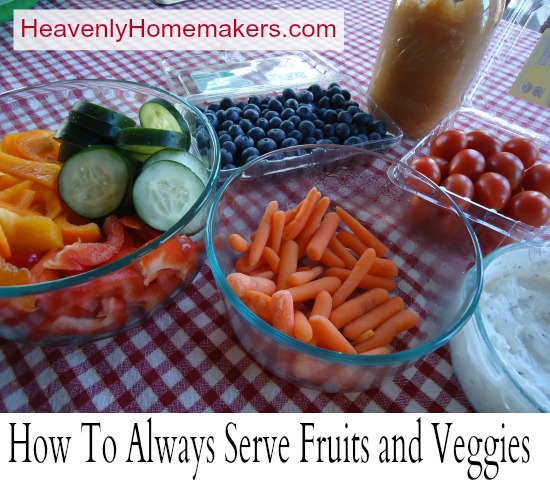
See that picture above? Cutting those veggies into a bowl took about 7 minutes, and will last our family through a couple of lunches. Washing the blueberries and grape tomatoes took just a few seconds. That picture shows what I have now gotten into the habit of putting out to go with our main dish at lunch. The kinds of fruits and veggies vary depending on what I find at the store that is reasonably priced and looks good. But quickly pulling those foods out of the fridge to go with a meal is crazy easy.
6. Serve salads often
Don’t tell me it’s hard. A two year old can tear lettuce.
7. Enjoy smoothies frequently
Smoothies are a delicious way to load up on the good stuff! As an added nutritional perk, I almost always add fresh spinach or other salad greens to my smoothies, along with different frozen fruits and some yogurt or kefir. You can’t taste the greens, but you still get the nutrients. Score!
8. Just do it!
I don’t care if all you do is (lovingly) slap a simple peanut butter and jelly sandwich onto the table or into a lunchbox for your kids. Take two minutes to serve or pack fruits and veggies too.
By the way, I also try to always have Homemade Ranch Dip in the fridge to put on the table with our veggies. There are many fruit and vegetable options – and eating a variety, buying in season, and watching for sales is very helpful. Here are some great, basic options to keep on hand to serve with meals or as snacks:
It breaks my heart when I hear moms longing to be at home with their children but have to send them off to daycare everyday. It’s the worst when after a too-short maternity leave a mom returns back to work daily in tears missing her baby.
For many women, working full time is simply not a choice. Perhaps she is a single mom or the family budget is truly just too tight. For many of us though, we believe that being a stay at home mom isn’t financially possible at first glance.
However, if you’ve been longing to be a stay at home mom, a closer look at your budget may show it’s more financially possible than you think with good money management.
It turns out working moms spend quite a bit of money just for the privilege of going to work. Once you take yourself out of the work force, you can save a surprising amount out of your budget.
How to Afford to Be a Stay at Home Mom in 3 Simple Steps
7 Ways you Save Money by Not Going to Work
Step one is easy. Just by quitting your job you can save a ton of money. You might just be surprised at how much going to work actually costs you!
1. Taxes
When you’re working, a big portion of your income goes to paying taxes. This will obviously vary depending on your household income, but it could be anywhere from 15-40% for federal taxes alone.
State taxes vary up to 11% of your income. There’s nothing like paying the government to go to work everyday.
2. Daycare
Daycare is a huge expense for working moms. The average cost of daycare for one infant in the US is $1000 per month. Having additional children in daycare adds on even more.
It may also be more convenient for stay at home moms to exclusively breastfeed.
(There are certainly many exceptions to this rule. One amazing mama from my La Leche League group just completed a full year of pumping at work!) If you do avoid buying formula you can save $150 per month.
4. Eating out
It is no doubt exhausting to be a mom who works full time outside the house. It would be very tough to come home every night day in and day out and make dinner and pack a lunch for the next day.
When you wake up exhausted in the morning, it would be really hard to drag yourself past Starbucks. If you had just one coffee, one lunch out, and one dinner per week, that could quickly add up to over $200 per month.
5. Clothes
When you don’t have to keep up appearances at work everyday, you can spend less on clothes.
You certainly don’t have to look like a scrub just because you’ve become a stay at home mom, but you can set the standard and decide whether spending a lot of money on clothing is a priority for you. You can probably dress a little more casually and at least avoid dry cleaning expenses.
6. Transportation
If you’re careful, your transportation expenses could go down when you are no longer commuting daily to work. The average worker spends somewhere around $400 a month commuting. If you pay for parking now, that will be another cost savings.
Would-Be Stay at Home Mom Budget
Allow me to make some hypothetical assumptions about the average working mom and how much she could save by not going to work.
The thing I’m obviously leaving out is health and retirement benefits. This can vary greatly depending on whether your spouse has a health plan you can join.
(Update: with the new “Obamacare” rules, your health insurance costs may go down drastically if your income goes down, but this isn’t an option if your spouse’s employer offers benefits.)
If you have savings you may opt for an health insurance plan with a high deductible to keep premiums more affordable.
As for retirement, it’s a sacrifice I’m willing to make as I know I won’t be at home forever and hopefully I’ll be able to make up for it later in my career.
Those two issues aside, you can see that there is a ridiculous amount of work related expense gobbles up most of a working mom’s pay check.
$3000 gross monthly median income for women in the US
-$600 in taxes
-$1000 in daycare expenses
-$250 in diapers and fomula
-$200 eating out
-$50 on clothing and dry-cleaning
-$200 on transportation
______________________________________
$700 net income
Step 2: Make Up the Difference with Budget Reductions
As you can see there is a fairly small difference in income once you look at how much is saved by not going to work.
You might be able to reduce other expenses through different lifestyle decisions to help make up the difference.
Could you cancel cable or shop around for a better insurance rate? Maybe you could choose to move to a more affordable home.
Then there is all of the indirect savings you could achieve by being a stay at home mom. Your kids won’t be picking up every little illness going around when they’re in daycare, and you won’t be taking time off to take care of them or taking them to the doctor.
If you’re able to cook healthier meals at home instead of going out, that will also help get your entire family healthier and reduce medical expenses.
Step 3: Make Up the Difference with Work at Home Income
Many stay at home moms supplement their income by working at home. The good news is you won’t have to make up 100 percent of your former income by working at home.
As shown above, you are actually savings quite a bit of money by being a stay at home mom. There is relatively little left over that you would need to earn to make up the difference.
You may be able to get contract work within your industry, or you may choose to try something completely new.
When deciding your contract rate, be sure to account for paying your own taxes, insurance, and retirement. Also, factor in for paid time off that you would usually get with full time employment.
How to Afford to Be a Stay at Home Mom
Everyone’s individual financial situation is different, but I hope this look at the budget of the average American family has given you a new perspective on how to afford to be a stay at home mom.
After all the expenses associated with going to work, many families will be very close to being able to afford to have mom stay at home. With a few more money saving strategies and a couple hundred dollars a month of work from home income, it really is financially possible to stay at home.
If you deeply desire to be a stay at home mom, I believe you can make it work with a bit of determination!
Do you want to be a stay at home mom but don’t think you can afford it? Are you making staying home work for your family? Please share your story in the comments.
Original article and pictures take growingslower.com site
I’m often asked how much Sucanat to substitute for white sugar, or if whole wheat flour can be substituted one for one with white flour. I decided to share a little bit about how I adapt “regular recipes” to make them healthier! Please know that when I say “healthier”…I’m not talking low fat. To me, healthier means real, whole food. Click on the following links so read about how I feed my family and why I love real, whole foods!! Be sure to also check out this entire series on Simple Steps Toward Healthy Eating.
Fats
If a recipe calls for vegetable or canola oil I switch it out one for one with melted coconut oil or melted palm shortening. It’s a little bit tough to measure out solid coconut oil to an exact needed amount. I just kind of “eyeball it”. If a recipe calls for 1/4 cup of vegetable oil, I make my best guess at how much 1/4 cup of coconut oil (or palm shortening) is while I’m scooping it out…then I melt it down in a small saucepan on the stove. If you are new to cooking/baking…you may prefer to melt it, then pour it into a measuring cup to be sure you have the correct amount.
If a recipe calls for margarine (I gag and then) I switch it out one for one with real butter. This means that if the recipe calls for 1/2 cup margarine, I use 1/2 cup of butter.
Usually butter and coconut oil can be used interchangeably. For instance, when I make muffins…sometimes I use coconut oil and sometimes I use butter. It depends on what I have on hand and what sounds good at the moment (coconuty goodness, or rich buttery flavor). If you are unable to eat dairy, you can substititute coconut oil for butter in most recipes.
I almost always use melted palm shortening to fry foods (like french fries, onion rings, homemade corn dogs, etc.). Palm shortening does NOT create the same freaky effects from frying that vegetable or canola oils create. This means that foods fried in palm shortening (or coconut oil) are NOT unhealthy!
I use olive oil if a recipe calls for just a few teaspoons or Tablespoons of vegetable oil.
Sucanat (or Rapadura, which is the same thing…just under a different name) can be substituted one for one with white or brown sugar. This means that if a recipe calls for one cup of white sugar…you can instead use one cup of Sucanat. However, I generally cut the Sucanat down just a hair because the flavor is stronger…and because it is more expensive…and because wow…do we really need that much sugar? :) Sucanat, by the way, is dehydrated cane sugar juice and the healthiest form of cane sugar I’ve found. You can read more about it here.
Honey can be substituted for white or brown sugar, but I usually use 1/2 to 2/3 the amount the recipe calls for. This means that if a recipe calls for one cup of white or brown sugar, I only use 1/2 to 2/3 cup of honey. Honey has a rich flavor and is sweeter than sugar. I have not found that substituting honey causes much difference in the consistency of a recipe, even though honey is a liquid and sugar is not. If anything, I find that honey makes quick breads, muffins and cookies more moist…and that’s never a bad thing if you ask me!
Real Grade B Maple Syrup can be substituted for white or brown sugar, but I don’t often bake with it (ooh, except for Coconut Macaroons!). I use maple syrup for liquid treats like Chocolate Milk and Smoothies and Ice Cream. If a recipe calls for corn syrup, I use Grade B Maple Syrup instead, substituting it one for one.
If you are using store-bought whole wheat flour, I find that this seems to be a heavier flour. Therefore, I recommend using a lesser amount than the white flour that is called for in a recipe. You may find that this is even true with my recipes that call for whole wheat flour, since I am using freshly ground flour. I receive quite a few comments, particularly on my Honey Whole Wheat Bread from people using King Arthur’s whole wheat flour or another store bought flour that they didn’t need to add in all of the flour the recipe called for. I suggest just adding flour until the dough is the correct consistency…then stop.
To make things a little bit easier…I created a free printable “Healthy Recipe Substitutions” download. Click the following link, print it off and keep it in your kitchen as a handy reference!
I’m a total, unapologetic optimist. Of course, I’m an INFP, so that’s not totally surprising. It drives my ESFJ husband nuts sometimes, but I’m confident he’ll come around eventually. (<– see what I did there? #optimism.)
Pollyanna was a favourite movie of mine as a child. The young character had a significant amount of trials and hardships in her young life, yet was determined to play “The Glad Game” that her father taught her before he died, with the sole aim of “finding something about everything to be glad about.”
The author of the book (which became a movie in 1960) received criticism for her portrayal of an unfettered optimism thought to be naive or blind. It’s the age-old wrestling between the realist, pessimist, and optimist streams of thought.
Eleanor E. Porter, the author, defended her heroine, saying, “I have never believed that we ought to deny discomfort and pain and evil; I have merely thought that it is far better to ‘greet the unknown with a cheer.'” (Source)
Personally, I believe that The Glad Game offers the key to a more contented life. To this end – Pollyanna has indeed left her mark on my life in a most remarkable manner.
I have witnessed in my own life that the hardships and tough seasons of life ebb and flow in our modern, digitally lives just as they did a century ago, but one simple thing remains as the chief determining factor in our happiness: perspective.
The Glad Game can help with that.
I could write a thousand words on the hard stuff in my life right now, but what use is that without also acknowledging the good? Without finding something about everything to be glad about? Maybe not right away, especially in times of deep sorrow or pain. Certainly not in a trite or careless way – not at all.
But eventually.
In tousled-out perspective. We can find it.
When Anne from Modern Mrs. Darcy posted a list at the beginning of the month of the “things that are saving her life right now,” I thought it was brilliant. And it reminded me of The Glad Game.
I don’t know about you, but I adore readings posts like that from my favorite writers. Fortuitously, then, a couple of other faves went and shared their own “saving my life” lists. Tsh shared hers at The Art of Simple, and then Stephanie shared hers on EntreFamily. Accordingly, I was inspired to jot down my own list, and share it with you.
Let’s play The Glad Game together?
Let’s acknowledge that while we may not know what comes tomorrow, we can certainly “greet the unknown with a cheer.”
10 Things That Are Saving My Life Right Now (The Glad Game)
We met with a real estate agent yesterday, and it was so symbolic to me. We’ve moved 14 times in under 13 years of marriage, and to say that we’re longing for some deeper roots would be an understatement of mammoth proportions. Our kids have lived in more houses than the number of years they’ve been on this earth.
When we moved to Ottawa it was such a fast turnaround that we had to rent. But this summer, we’ll buy a house and move in, and we’ll move again approximately NEVER. (Ok, probably not literally. But anything over 5 years sounds like forever with our history, so…)
The tender little bit of hope for some more permanent roots for our family is 100% saving my life right now.
In the summertime, I’m barefoot as much as possible – at home, around the neighbourhood, etc. But the Ottawa winters have 4-feet-of-snow and sub-zero temps sort of weather, so warm feet are a must.
I got these slippers for Christmas, and they are DIVINE.
I do product reviews from time to time here at R&H, and as you can imagine – not all products end up becoming long-term faves. However, the argan oil that I raved about three years ago still saves my life on a daily basis – the stuff is amazing.
Different parts of Canada vary widely in their climates. While some parts have milder temps and less snow in the winter, they also endure endless grey days without seeing much sun.
I’m grateful that I live in a city where there’s enough snow to really play in and enough sunshine and blue skies that I need to remember to keep sunglasses in the minivan year-round.
Right now, I’m gratefully focusing on the numerous benefits and perks of being public schoolers – the tight-knit community, the incredible teachers that champion my kids, and the daily diversity that they’re exposed to, both in terms of people (our city is so beautifully multi-cultural), and in terms of learning (my 7-year-old boy has wonderful exposure to the arts in his regular curriculum, including visual arts, drama, and dance, which I’m thrilled about.)
Kicking my stay-up-too-late habit has profoundly changed my life for the better. I know, I know – I’m prone to hyperbole. But this is legit, and I’m unbelievably grateful to myself for making this change.
We were never any good at budgeting. Not at all. Especially during our most cash-strapped times – it was far too demoralizing to look at the numbers in black and white each month when the bottom line was always red, no matter what. Not budgeting probably made things even harder, but it felt easier to ignore it at the time.
Now that we’re making enough to pay the bills, we’ve started tracking things again. I’m bound and determined to pinch every penny I can this year to pay off all of our debt.
Budgeting has become shockingly fun. (Who am I?!?)
After falling head over heels for Lorelai Gilmore and basically all of Stars Hollow in its entirety, I decided to give NBC’s Parenthood a whirl. (This poster on Etsy would make my life so complete, but I haven’t bought it because of the previously aforementioned penny-pinching.)
It’s a ridiculously brilliant show. I am especially appreciating the insightful portrayals of big feelings in common family life situations, and my inner empath is going beserk, tearing up at every other scene.
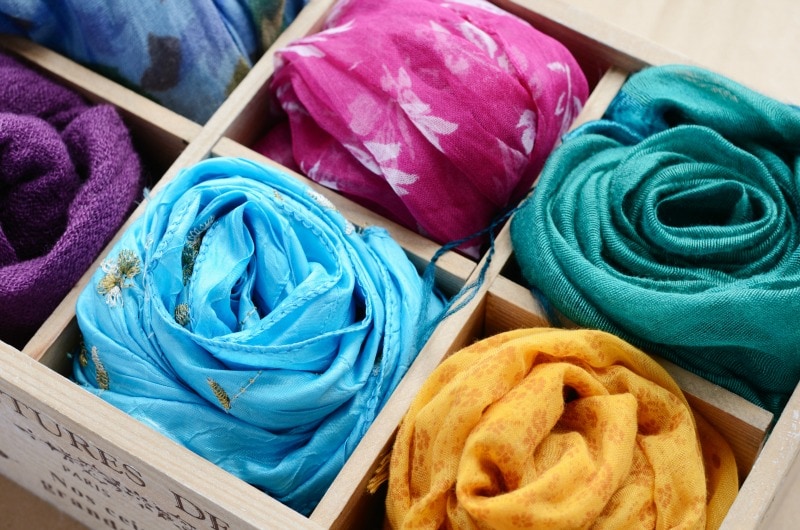
In the fall, winter, and spring, I wear a lightweight scarf all day, every day. When I leave the house, I layer a heavier knit scarf on top.
It feels like a perpetual hug, and it makes me so unreasonably happy. It’s the little things, I guess? Scrolling down this page makes me all warm and tingly.
When Chris went to Alabama last week to fly loop-de-doo’s* in airplanes, I solo parented for 7 days and 7 nights. I’ve had a lot of experience in this department, so I knew what needed done: brownies.
I made my grandmother’s brownie recipe – modified to be gluten-free, and using coconut oil because I’m toying around with going dairy-free, too. (No, I haven’t shared the recipe yet – I’m still working on replacing the white sugar with natural sweeteners. Once I’m satisfied with the modifications, I’ll share.)
They were just the reward I needed each night after the house was finally quiet and the dishwasher was humming away. (Except that the pan only lasted 4 nights. So sue me.)
*Not the technical aerobatic term, apparently.
So there you have it. These are the little things with mighty magical powers, helping me ‘greet the unknown with a cheer.’
In a cold and snowy winter, when my husband goes out of town, or works late, and we’ve living in our 13th or 14th home, and I’m battling adrenal fatigue that tries to suck the life out of me, and the kitchen faucet breaks, and nobody can find clean socks three days in a row…
I play The Glad Game.
And it saves my life.
Original article and pictures take redandhoney.com site
You might have already made the organic transition, but have your children? The green movement is upon us, and we’ve already switched to using sustainable materials when building new homes and developed hybrid cars. These eco-friendly practices should have been transposed into your diet too. As an increasing number of natural food stores like Goodness Direct and organic brands surface, it is becoming easier than ever to feed your family organically.
Organic eating refers to the practice of eating food which hasn’t been chemically treated. Some people question whether the higher price of organically farmed produce actually results in better quality, healthier food. However, recent studies by experts have found positive benefits, and when it comes to your children, the findings suggest that it is well worth spending more and buying organic for them, too.
Health Benefits
Dr Therese Pasqualoni, who has spent over fourteen years researching nutrition, physical activity and stress management, has voiced concerns over children’s diets, and stressed that organic foods are far more beneficial than conventional ones. A study published in the British Journal of Nutrition backed up Dr Pasqualoni’s assertions, finding that among 815 two-year olds, those who consumed organic dairy products had a reduced incidence of eczema and wheezing.
Preventing Mental Health Issues
The University of Washington conducted a study in Seattle that produced some very interesting results. Their research found that pre-schoolers who ate primarily organic foods were exposed to fewer organophosphate pesticides than children eating primarily conventional foods. This was significant as a 2006 study by the BBC had reported that pesticides found in fruit and vegetables, and the decreased nutrients in non-organic produce, could cause mental health issues like depression and memory problems in children and adults.
Battling Attention Deficit Disorder
An increasing number of children are being diagnosed with Attention Deficit Disorder (ADD), a recurrent pattern of behaviour characterised by short attention spans, impulsivity and hyperactivity. This condition is usually treated with Ritalin. Ritalin is a stimulant that is used to treat daytime drowsiness and chronic fatigue syndrome. As with many drugs, it can have side-effects, including anxiety, nervousness and insomnia. A holistic alternative which avoids the risk of side effects is available in the form of a plant-based nutrition programme. The treatment works on the foundation that there is a relationship between diet and disease, working on the theory that everything the human body needs to live a long, disease-free life is provided by the Earth. High sugar consumption and a diet of processed foods and additives have been identified as possible ADD risk-factors. By eliminating the three from your diet, the theory posits that you should see an improvement. It stresses that parents should feed their children organic produce because it has the maximum nutrient density, and a minimal amount of pesticides and other harmful chemicals.
Now that you know the benefits of organic food for your children’s diet, shop smart and try swapping some of your more conventional shopping choices for organic alternatives.
My son is all boy. From the moment he wakes up until his head hits the pillow at bedtime, he is running. Or jumping. Or climbing. He’s on the go and has more energy than my husband and I combined.
He’s always been like this. Throughout my pregnancy, he was one wiggly, kicky little baby. And he was a squirmy newborn, an early crawler and was walking before he turned 1. While it may be a little tiring to try to keep up with him, I’m used to his high energy levels by now.
How My Family Has Dealt with Food Coloring {Accidentally Green}
Sometimes, though, all of his energy seems to take an excessive, aggressive turn. It’s been happening since he was 18 months old, and at first Prince Charming and I thought it had to do with his age. We watched Big Brother’s cheerful, energetic disposition turn aggressive – including violently and repeatedly banging his head against anything. Even concrete. We suspected something was wrong, and as his forehead began to turn deeper shades of purple with every head banging episode, we longed to help him.
I stumbled across online testimonies about other children with the same problems, but they improved when the natural food color annatto was removed from their diets. I ran to our pantry and refrigerator to search for annatto in our foods – and sure enough, the cheesy crackers we had given Big Brother for occasional snacks contained annatto, as well as the orange cheese he regularly ate and some ice pops. In an attempt to curb his extreme behavior, I threw out everything containing annatto or Red No. 40.
From that night on, the only major changes we made as a family were reading labels on food before buying, eating white cheese instead of orange cheese, sticking to fresh foods, and watching what kind of vitamins we give him. (While many vitamins include artificial colors, most naturally colored vitamins include annatto.) Surprisingly enough, those small changes have helped Big Brother change back to his normal self.
When I’ve mentioned the topic to our pediatricians throughout the years, they’ve dismissed my concern like it’s highly unlikely. I know my son, though. And I know how he acts when he does eat artificially colored foods – he’s crazed. Throw just a little bit of annatto in, and within a day or two he’s back to spazzing out and repeatedly banging his head.
For me, I don’t care what the FDA decided last week, or even what my pediatricians say about the issue. I know my son has major behavior issues when he consumes artificial colors and annatto. When they’re removed from his diet, he’s a pleasant little boy filled with energy. Does he have occasional temper tantrums? Of course. He’s 3. But they’re manageable – not alarming.
Is your child sensitive to food coloring? What steps have you taken to help him or her?
Original article and pictures take accidentallygreen.com site