вторник, 3 июля 2007 г.

3 Strategies That I’m Using to Save on Groceries This Month

3 Strategies That I’m Using to Save on Groceries This Month
These three strategies for saving money on groceries have been really working well for me this month. #2 is pretty unconventional!

I am no stranger to a tight budget. In fact, you might even say that we are reluctant BFF’s. And you know what? For some reason, it’s always the grocery budget that gives me the most grief.


For me (and most of you reading this blog), it’s not just about filling your cart for insanely low prices with boxed and canned food-like products with your mad coupon skills and 2-for-1 sales. Real food costs more – it’s a sad but true reality.


Ramen noodles and Wonderbread may be cheap, but I just cannot bring myself to sacrifice my nutritional ideals to that level. Besides, I don’t believe that cheap food ends up saving you much in the long term. There are a lot more factors to consider, like the health care costs, a reduced quality of life, and the inevitable affinity for over-priced junk food that doesn’t even satiate. (Sugar: I’m lookin’ at you, punk.)


So what do you do when you’re on a tight budget but still want to serve real, nourishing food to your family? Throw your ideals out the window and just give up because it’s too hard? Nah, that’s the wimpy response.


I used to find myself swinging between splurging too much (organic brands and fancy ingredients and choice cuts of meat at the farm, oh my!) because I’m frustrated and in denial, or buying only the bare bones items (and tsk-tsk’ing myself for not raising my own meat and milking my own cow, never mind that we live smack in the middle of the suburbs), which then usually makes my life so difficult that I wind up eating out because I’m so fed up with trying (unsuccessfully) to find time to make every last little thing from scratch. *cue crazy eyes*.


Neither extreme is very helpful.


It turns out I don’t just need to find the ever-elusive “balance” in my grocery budget spending. I need to wise up and employ some specific strategies that work far better than all the angsty “store-bought/sanity vs. homemade/health??” grocery aisle agonizing in the world.


green beans

Lately I’ve felt a little better about our grocery spending, and I have identified three main reasons for that. Here are the three sort of random – yet significant – things I’ve been doing:


Our monthly budget has a line for groceries, and then a (verrrrrry small) line for “entertainment”. It’s usually spent on a single visit to Five Guys in the middle of a day of errands. It’s supposed to cover any eating out that we happen to do (usually a last-minute thing), but if we overspend then I take it from our grocery budget.


So… the first line of defence on keeping my grocery budget in check is to plan ahead better (I wrote about my tips for success as a Type B menu planner here) and eat out less! We are using the online menu planner Plan to Eat, and loving it.


After a year or two of living in survival mode and being very protective against anything that adds to our stress-load, it has become an area of weakness for us to make the convenient, easier choice, instead of the harder, more frugal one. It’s never anything fancy or extravagant, but five bucks here and ten bucks there really add up over a month, so we’re making a strong effort to start changing that.


[Related posts:]

19 Crunchy Compromises I’m Willing to Make During Survival Mode

Let’s Talk About Healthy Living Burnout


2. Strict Bedtime


At first glance, this might seem to have little to do with saving money on groceries. Well believe it or not, it may actually be the single-most relevant thing I’ve done in the last month.


I wrote a few weeks ago to introduce my journey with adrenal fatigue. Now that I’ve begun to put some strategies in place for healing from that, I’ve seen the tip of the iceberg in just how bad my energy levels were. I have gone to bed consistently early for a week, and I’ve cooked and baked from scratch more in the last week than in the last three months combined. It has made that much of a difference for me.


couch

I’ve learned that if I want to succeed with my goal to plan ahead and cook more, and thus eat out less… I have to take care of my health, get my rest, and have the energy to pull it all off. There’s simply no other option.


3. Stretch the Protein & Simple Meals


We are not a Paleo family. We are not even grain-free. We settle more along the lines of WAPF ideals – properly prepared grains (soaking/sprouting/sourdough), fermented foods, properly-raised meats, fresh fruit and veg, etc. But since we don’t like to fill up on lots of store-bought starches or sugary treats, we’ve come to realize that healthy fats and proteins must make up a significant part of our diet.


In order to continue to afford the real-food versions of these things instead of the cheap, industrially-produced kind (ie. vegetable oils and factory-farmed meat), we must choose to stretch them. Meatless meals work well for this, but we prefer minimal-meat meals.


We also almost always choose the cheaper cuts of meat – like whole chickens (from which we can make broth, which drastically multiplies the number of meals we get out of it), and ground beef. Steak is for birthdays, and convenience cuts of chicken are few and far between. Our grocery budget would easily double if we ate roast beef and boneless chicken cuts every night.


By stretching our protein, our meals become simpler. We don’t tend to get fancy with our menu planning, because gourmet recipes typically cost more. Real food doesn’t have to be fancy. Basic and simple are just fine for us, for now.


how to save on groceries

This post sponsored by Plan to Eat. Because eating at home should be easier.


300x250

Original article and pictures take redandhoney.com site

среда, 27 июня 2007 г.

3 Steps to Finding an AWESOME Doctor to Treat Hypothyroidism

3 Steps to Finding an AWESOME Doctor to Treat Hypothyroidism

Finding an awesome thyroid doctor is some tough work! Do you know what I mean? Are you feelin’ my pain?


3 Steps to Finding an Awesome Doctor to Treat Hypothyroidism!
You've got to educate yourself. Know what tests for hypothyroidism are essential for your doctor to run. Know if your doctor is on the right track. https://www.intoxicatedonlife.com/2014/02/27/3-tips-finding-awesome-thyroid-doctor/

Doctors who don’t believe you have a thyroid problem


Doctors who only want to test TSH


Doctors who won’t prescribe natural desiccated thyroid


Doctors who don’t want to run the tests you request


Doctors who under-dose


I’ve experienced it all! I’ve experienced the frustration, the disappointment, and the exhaustion of going through doctor after doctor who just does not understand how to treat hypothyroidism.


1. Educate yourself.


Educating yourself is one of the first and most important steps of finding a thyroid doctor. Yes, a doctor is supposed to treat you. No, you can’t just trust that any doctor will know the best way to do that. In fact, it’s been my experience that most doctors don’t have a clue how to treat hypothyroidism. (I don’t say this out of pride, but out of a very real sense of frustration.)


You’ve got to educate yourself. Know what tests are essential for your doctor to run (hint: they don’t always run the right ones). Be sure to know about foods that could be destroying your thyroid. You have to know if your doctor is on the right track, or if it’s time to fire your doctor. Yup, you might have to fire a doctor (don’t forget, he/she works for you).


Learn all you can about hypothyroidism so you can ask questions, understand what the doctor is talking about, and advocate for yourself!


Books to get you started:


Below are some great books that will get you started on your education. Read them. Be informed. Information is truly the first step to finding your doctor.


2. Start Your Doctor Search


Now that you’ve got some basics under your belt. You know a bit about thyroid disorders yourself, it’s time to find a doctor that (hopefully) knows more than you. If you’re going to find a doctor who will get you on track, you’re going to have to do your research. Here are a few places to start.


Check out Sites with Patient Submitted Doctor


Thyroid Change Patient Recommended Doctors: Listings for US, Canada, and Australia


Look for Doctors who Prescribe Natural Desiccated Thyroid


ThyroidDoctors.com: This site provides listings of doctors in your area that will prescribe NatureThroid and/or Westthroid—natural desiccated thyroid prescriptions.


Search for Doctors who practices: Integrative, Functional, or Holistic Medicine


These doctors are more likely than some doctors to be familiar with treating hypothyroidism.


Ask Your Friends!


Do you have friends who deal with thyroid disorders? Chances are you do. They may have a doctor that’s been helpful that they could refer you to.


3. Interview your doctor


The next step in finding a new doctor is to interview them. Yup, you heard me correctly. Just because a doctor is listed in one or more of the above places does not mean they’re going to be the doctor for you.


Now’s the time to make sure your doc can answer some questions correctly. Do you know what questions to ask your doctor? If not, be sure to check out these 5 questions to ask your doctor.


This final step in finding your doctor is so important. Now isn’t the time to be timid. If your doctor isn’t willing to be your partner in helping you regain your health, they aren’t the one for you.


Have you found a great doctor to help treat your hypothyroidism? What tips do you have to help others find a great doctor?


You may also want to check these out:


“How Doctors Gamble With Your Health: Testing & Treating Hypothyroidism”


“Could Wheat Be Destroying Your Thyroid?“


Original article and pictures take www.intoxicatedonlife.com site

3 Reasons Why Our Family Avoids Sleepovers

3 Reasons Why Our Family Avoids Sleepovers
Our family has decided to say no to sleepovers. Check out the 3 reasons why our family avoids sleepovers!

Our family has decided to say no to sleepovers. Check out the 3 reasons why our family avoids sleepovers!

Our family has decided to say no to sleepovers. Check out the 3 reasons why our family avoids sleepovers!

Our family has decided to say no to sleepovers. Check out the 3 reasons why our family avoids sleepovers!


Our family has decided to say no to sleepovers. Check out the 3 reasons why our family avoids sleepovers!

Our family has decided to say no to sleepovers. Check out the 3 reasons why our family avoids sleepovers!

New baby on the way? You don't want to miss these 5 must-have items for babies and new moms!
5+ Must-Have Items for Babies & New Moms

How do you address the rules of no sleepovers with your kids, especially when dealing with birthday parties?


My daughter is almost 4, but I already see the excitement already beginning. Her friend we babysit regularly has parents who are divorcing. Last weekend was her first time to go spend the weekend at her dad’s new home. I helped her pack since we were babysitting her all day. She was very excited. When her dad picked her up, my daughter said she wanted to do that with her dad too. I tried to explain how it’s really more fun that her daddy lives with her instead of only seeing him every other weekend like her friend does. My daughter describes my husband as “fun daddy” & they do fun things together regularly- it was the idea of the sleepover that captivated her. (A couple months ago we went to visit family, so she understands sleeping at other’s houses & had fun.)


I have a good friend who is a Counselor & she’s heard a lot in sessions and sees daily struggles related to scars from childhood. She’s made a rule for her son that he can only have sleepovers with those she knows deeply- grandparents and a few of her friends she’s known a long time and knows their hearts/character. Growing up, my father-in-law always told my husband and his sister “the cockroaches come out at night.” My husband still says that regularly, especially when we hear about another crazy thing in the news.


While I was never molested I was exposed to plenty that wasn’t in line with values my parents wanted for me:

– a friend whose parents stored their bookcase in her room- which had a Joy of Sex book on it. She knew the book well. I’d heard about sex at school, then that was my next understanding of it. Certainly messed with my understanding of what sex was designed to be into my adulthood.

– at a 3rd/4th grade birthday party a mother added a splash of gin to each of our glasses of punch

– rated R movies even as a young elementary child

– a friend’s dad who walked around in his tidy whiteys around bedtime/first thing in the morning. (from a family where I never saw my dad in his underwear and that was a shock and even at 3rd grade I remember thinking that was gross. lol)

– lots of language & attitudes that my parents would not have wanted me exposed to/adopting

– I witnessed a friend and her dad having a raging screaming match with each other for about an hour. It was shocking/a bit scary to be around an adult that enraged, but I was stuck- her dad was in the doorway. I also felt pretty awkward that I couldn’t leave the room so they could discuss their private issues by themselves.

*I don’t think I told my parents any of those things. I didn’t think to. But now I’m sure could have benefitted to process some of it in a healthy way with them.


Original article and pictures take thehumbledhomemaker.com site

четверг, 21 июня 2007 г.

3 Quick & Easy Ways to Boost Your Health Today

3 Quick & Easy Ways to Boost Your Health Today

These quick and easy ways to boost your health can all be accomplished today!


quick and easy ways to boost your health today!

With the plethora of information on how to improve your health on the internet today, it’s so easy to become frustrated when you feel like you just can’t measure up.


With so many options on ways to boost your health, you may not even know where to begin.


Should you start a new exercise routine?


Transition to a whole foods diet?


Change your skincare products?


Begin using natural and non-toxic household goods?


The possibilities of ways to boost your health don’t just seem endless; they are!


I’m a huge advocate of taking baby steps. When I forge full-force ahead on any goal–health-related or not–I burn out and end up worse off than before I even started!


The following are three quick and easy ways to boost your health. You can take action with all three of these today with very little time or effort!


Drink water in the morning

1. Drink more water.


This is probably the simplest health booster ever, yet it is one that I personally struggle with.


I drink a cup of coffee first thing in the morning, and it’s often not until I feel thirsty that I will realize I haven’t drunk anything else!


I’ve read that once you are physically thirsty you are already beginning to get dehydrated. Another sign of dehydration is chapped lips.


I am working on remedying this by carrying a water bottle around with me that reminds me to continuously drink water all day long.


I actually find I struggle with this more, though, on the days when I don’t leave the house (which can be most days for many homemakers!).


Filling up a large glass with water first thing in the morning and keeping it in a prominent place in my home is helping me to remember to drink more water.


I personally enjoy plain water as my beverage of choice, but if you prefer something with a little more flavor, you can always try these homemade flavored waters!


take a daily probiotic supplement

2. Take a daily probiotic supplement.


Before I became a mom in 2008, I had never even heard of probiotics–much less had incorporated their use into my daily routine.


In fact, when I purchased my first probiotic supplement, I was a little apprehensive about even using it. I had read probiotics were great for boosting your health, but I wasn’t quite sure exactly what they did or what they were.


Now, my whole family takes a probiotic every single day!


In short, probiotics help keep both the digestion and immune system functioning at optimal levels. These two systems are heavily related. Probiotics works in your digestive tract, where 70% of your immune system is located. Some people say that health actually starts in the gut!*


The first probiotic brand that our pediatrician recommended to me was the Culturelle® Health & Wellness Probiotic. The probiotic in Culturelle Health & Wellness works in the digestive tract to help to keep your immune system healthy. With just one capsule per day, the immune system is provided with a clinical strength serving of 100% Lactobacillus GG containing 15 billion live active cultures.*


I am now taking my supplements as part of my nighttime routine, and just one probiotic capsule per day can go a long way. It’s an incredibly quick and easy way to support your health.


bedroom-462772_640

3. Go to bed earlier.


This is probably the easiest way to quickly boost your health, but it takes discipline. For me, it takes cutting my computer time off by 9:00 p.m. (I don’t always do this), or else, like a friend says: “My butt gets glued to the couch.”


The later I stay up, the harder it is to make myself go to bed!


I finally started implementing a good nighttime routine about six weeks ago, and I’ve never felt better. When I go to bed between 10 and 10:30 p.m., I seriously feel like a completely different person!


Sleep in vital to overall health–and is integral in healing adrenal fatigue (a.k.a. burnout).


These three quick and easy ways to boost your health are simple enough that you can begin implementing them today!


3 quick and easy ways to boost health

What do you do daily to keep a healthy lifestyle? Do you have any tips for quick and easy way to boost your health?


Disclosure: * These statements have not been evaluated by the Food and Drug Administration. This product is not intended to diagnose, treat, cure, or prevent any disease.


Culturelle Probiotics sponsored this blog post. The opinions and text are all mine.


Original article and pictures take thehumbledhomemaker.com site

понедельник, 18 июня 2007 г.

3 Practical Ways We’re Teaching Our Kids About Money

3 Practical Ways We’re Teaching Our Kids About Money

Want to instill wise financial management skills in your kids? Here are three practical ways we’re teaching our kids about money…


“When should we start teaching our kids about money?”


We hear this question a lot — from friends, from people I meet at conferences, and often from readers. Our response is always the same, “As soon as possible!”


My husband and I believe wholeheartedly that it’s never too early to start teaching your kids about money! The sooner they can learn the value of money and how to handle money, the sooner they can begin to develop a strong foundation for wise money management.


We started teaching all of our kids about money from the time they were about two. When they are old enough to not swallow money, they are old enough to learn about how to start using it well! ��


My husband and I were blessed to come from homes where wise money management was modeled. And we are forever grateful to our parents and grandparents for the gift they gave us in this. We know that there’s no way that we would be in the financial position we are in if it were not for the foundation they gave us.


It’s our hope that we can pass on this same foundation to our kids, too. Which is why it’s so important to us to make teaching our kids about money a very important priority in our home.


Here are three practical ways we are teaching our kids about money:


1. We Talk About Our Own Money Choices


Since the time our kids have been toddlers, we’ve talked about money and the choices we’ve made when it comes to finances. We’ve started out in small ways and gradually shared more as they’ve asked more questions.


We’ve talked about why we live on a budget, why we save up and pay cash for things, why we wait to make purchases why we don’t use credit cards, why we don’t go into debt, why they are currently sharing a bedroom, and why we don’t have a mortgage.


In addition to talking about our money choices, we’ve also sought to model wise money management before our kids. They hear us talking about our budget together. They see us making sacrifices to pay for things. They watch us paying cash for things. They see us deciding not to buy something because it’s not a good enough deal.


I believe that it’s very important to teach through our words and through our life. Because often more is caught than taught.


This was definitely true for me. My parents taught me that money is a tool. In the hands of wise stewards, it can be put to good use and make a huge impact. In the hands of those who are unwise, it can be wasted and blown with nothing to show for it.


With their lives and checkbooks, they modeled the importance of being wise in how you use and manage money. It wasn’t about saving money for saving money’s sake, but so that you could use that money saved to impact and help other people. To invest in things that matter, to bless people, to donate to causes you believe in, and to give generously.


Seeing my parents’ sacrifices and creative commitment to living debt-free and how it put them in position to be able to give generously because they worked so hard to no longer have a house payment was a huge inspiration to my husband and me.


How to Teach Through Every Day Life

Recently, I took Kathrynne (12) and Silas (7) with me to Kroger. I had so much fun going through the aisles with them, showing them simple ways I save money at the store.

I shared with them that Jesse was in law school, we only had $17-$30 a week to spend on groceries, so I had to get very creative with menu-planning, shopping the markdowns, playing the Drugstore Game, and using coupons.

I told them how I would dumpster dive and search through the recycle bins for coupons. Between pairing the coupons and the markdowns, along with creativity, we were able to survive on a minimal budget.

We played The Markdown Game at the store — looking for the yellow markdown stickers and then, once we found them, deciding whether it was a really good deal or not. Teaching them that some deals aren’t as good as they seem and that it’s not a good deal if you don’t have the money for it is a fantastic way to connect the dots for them and increase the value of the dollar in their mind.

So we discussed our budget, and I helped them decide whether or not an item fit in our budget. We had so much fun doing this together — and we came away with some really great deals, too!

Near the end of the shopping trip, one of them said, “So when I go away to college, I can do this, too. I can afford to live and not go into debt.” Yes!


2. We Give Them Opportunities to Handle Money


We have our children start paying for things from a young age. In fact, from the time all our children were three or four years old, they had their own spending money that they had earned by doing chores and projects for us.


When we’re out shopping, they can bring their own spending money and spend it however they’d like (within reason!). This helps them learn valuable money management skills and also prevents the gimme attitude that can quickly pop up when out shopping.


If a child sees something they want and they ask me if we can buy it, my response is always, “Did you bring your money?”


I also love the real-life skills our children are learning from taking their items up to the register and paying for them themselves. They learn about counting change, interacting with sales clerks, and making sure they have enough money to pay for their items in the first place.


One of the greatest joys of paying our children for doing chores has been watching them become generous givers. We encourage them to set aside a portion of their money for giving and we regularly talk about the needs around the world.


We’ve been so proud to watch our children fund Operation Christmas Child boxes and buy goats and chickens and help fund a water project for those in other countries through Samaritan’s Purse. Truly, there has been nothing more rewarding as a parent than seeing our children want to follow our family’s mantra to “Live simply so others can simply live.”


3. We Let Them Make Money Mistakes


When our children to use their own spending money to buy things they want to purchase, we don’t give a whole lot of input or guidance — unless they ask us for it. Why?


Because we want them to learn how to think through the wisdom of purchases on their own. We won’t always be around to guide their purchases, so we want them to learn to think through what the best deal is and what the best use of their money is without a lot of prodding from us.


We also want them to make money mistakes. This might seem harsh, but we’d much rather have them make $3 mistakes now when they are little to hopefully prevent some $3,000 and $30,000 mistakes down the road.


They’ve learned a lot of lessons when they bought cheap items that were broken within a few days and they’ve learned that spending all your hard-earned money on some impulse purchase can often lead to regret. These instances have resulted in great discussions about how to carefully think through purchases and how to make sure you’re making the best use of your money.


Looking for more resources to help teach your kids about money?

Check out Beth Kobliner’s brand new book Make Your Kid a Money Genius (Even If You’re Not) that just came out today, February 7, 2017.

Beth Kobliner is one of the nation’s leading authorities on personal finance for young people, and in this book she shares wise, practical, relatable advice to help parents teach children how to be smart about money.

Make Your Kid a Money Genius (Even If You’re Not) is a jargon-free, step-by-step guide to help parents of all income levels teach their kids from ages three to twenty-three about money. The content in the book is based on the latest research from the fields of psychology, child development, and behavioral economics.

What I love most about this book is that it is full of “teachable moments” that allow parents to learn how to teach their kids character traits that are important in all aspects of life: a strong work ethic, the ability to exert self-control and to weigh our choices carefully, the perseverance to work toward distant goals, and a giving spirit.

I don’t agree with all of the advice in the book — especially the parts that make it seem like debt is just an expected and normal part of life — but I think there is a lot of incredibly valuable information in this book and it’s presented in a simple and easy-to-understand format. I think it would be a very helpful to any parent who is looking for some guidance and practical help to set your kids up for financial success.

The book also features various financial chapters with each chapter divided into the many stages of a child’s development (i.e. toddler, elementary school, college, etc.) for parents to read through or reference whenever they need to.


(Note: This post was underwritten by Beth Kobliner. Read our disclosure policy here.)


Subscribe for free email updates from Money Saving Mom® and get my Guide to Freezer Cooking for free!


Original article and pictures take moneysavingmom.com site

3 Kids Supplements That I Give To My Small Humans

3 Kids Supplements That I Give To My Small Humans
Three Kids Supplements That I Give To My Small Humans - Holistic Squid

Do I have a kids multivitamin that I love? Not so much. I'm a big believer in serving nutrition on a plate – not in a pill. That said, there are a handful of kids supplements that should be in regular rotation.


These three kids supplements will only do a body good. This is true for kids struggling with eczema, allergies, and mood swings. And it's true for kids that are already teeming with energy and vibrant health.


Three kids supplements for every small human


Even if your kid eats a “healthy” diet and spends plenty of time outdoors in the sunshine, chances are good that vitamin D requirements aren't being met. There's also widespread exposure to drugs and chemicals that put a strain on digestive health.


So, small amounts of seafood (if any) along with lots of seed and nut oils, time spent indoors, and modern conveniences filled with drugs and chemicals. This is your reality. And when it comes to nourishing young bodies – it's not ideal.


Fortunately, you can supplement. And if you have ever wondered which kids supplements are most important, here's a short and sweet list that touches on what kids really need.


#1 – Fish oil


Kids and adults alike thrive with an abundance of long-chain omega-3s. For children, this need is especially important, considering these special fats support brain development.


In short, your child's diet should be filled with lots of long-chain omega-3s relative to omega-6 fatty acids – which are found in grains, nuts, seeds, and common cooking oils. The problem? Most kids aren't eating foods that are high omega-3s. But they are eating plenty of grains, nuts, seeds, and vegetable oils.


Examples of long-chain omega-3 fats are DHA (docosahexaenoic acid) and EPA (eicosapentaenoic acid). These omega-3s are found mostly in seafood. You can also get small amounts of DHA from:


  • Eggs
  • Organ meats
  • Fat of well-raised animals

Besides the role they play in brain development, long-chain omega-3 fats are vital for healthy eyesight. They also safeguard against inflammation, which means they play a role in how your child's immune system works.


BEWARE: If you offer your child flaxseed oil as a source of omega-3s, there's good reason to reconsider. The omega-3s from plants like flaxseed must be converted into a usable long-chain form. Not only is conversion poor – but depending on genetic makeup, your child might have a very difficult time pulling brain-important DHA from short-chain plant oils.


Kids should receive between .7 and 1.6 grams of omega-3s each day, depending on their age. Unless they’re eating a 3 ounce filet of salmon every single day, it can be hard for them to get enough through diet alone.


You can find my favorite fish oil here.


#2 – Probiotics


Probiotics support your kid's immune system, digestion, and brain development. Issues like ADHD, autism, eczema, allergies, and asthma all have a reputation for being linked to an unhealthy gut. And unfortunately, gut imbalances can be traced back to some very common trends, including:


  • Antibiotic use
  • Formula use – instead of breast milk
  • Refined, processed foods

While some foods – like yogurt – are marketed for their probiotic power, pay close attention to the ingredients. Oftentimes, you'll find plenty of added sugar. Sometimes, there will even be artificial colors and flavors. You're also not likely to find bifidobacteria in most yogurts, which is a probiotic strain that tends to dominate the gut of healthy babies and has been linked to a number of health benefits.


When shopping for a probiotic-rich yogurt, look for one that's unsweetened and organic. Even better, make you own using raw milk.


Besides yogurt, I recommend a high-quality probiotic like this one.


#3 – Vitamin D3


This essential nutrient is necessary for immune system balance, strong bones, a healthy brain, and cancer prevention. With the help of a little sunshine, the body can make enough vitamin D. However, there are plenty of obstacles that put children at risk for vitamin D deficiency.


For starters, many kids spend their days indoors for class and after-school events. They’re simply not getting the recommended amount of sunlight needed for adequate vitamin D levels. Genetic variations can also determine how much bioavailable vitamin D is floating around and free for immediate use.


Besides sunshine, food can be a wonderful source of vitamin D. We're talking BACON.


High-quality bacon and lard from pigs that have spent time outdoors foraging are an excellent source of vitamin D. Carnitas cooked in lard for melt-in-your-mouth perfection or a side of bacon is easy for any kid to love. Other sources of vitamin D comes from a spectrum of seafood, including:


  • Wild salmon
  • Sardines
  • Mackerel
  • Oysters
  • Fish roe

In addition to seafood, you can find vitamin D in a high-quality cod liver oil, like this one. To make cod liver oil kid-friendly, mix it with a little fruit juice.


In order to really know your child's vitamin D levels, you might want to use this home test kit. Then choose a kids supplement for vitamin D3 and follow these steps:


  • Start with 35 IU per pound of body weight. That’s approximately 1,000 IU for healthy children under the age of 2. 2,000 IU for children over the age of 2. And 5,000 IU for an average sized adult or adolescent per day.
  • After 2 months of taking the recommended dosage, check your vitamin D levels again.
  • Adjust your dose and retest as needed. Adequate vitamin D levels fall between 50-80 ng/ml.

For kids and adults alike, I like these liquid vitamin D3 drops.


Do you give your kids supplements?
Let me know in the comments below!


7 Day Healthy Living Makeover - Holistic Squid

Original article and pictures take holisticsquid.com site

понедельник, 11 июня 2007 г.

3 Kid-Friendly Recipes For Fall

3 Kid-Friendly Recipes For Fall

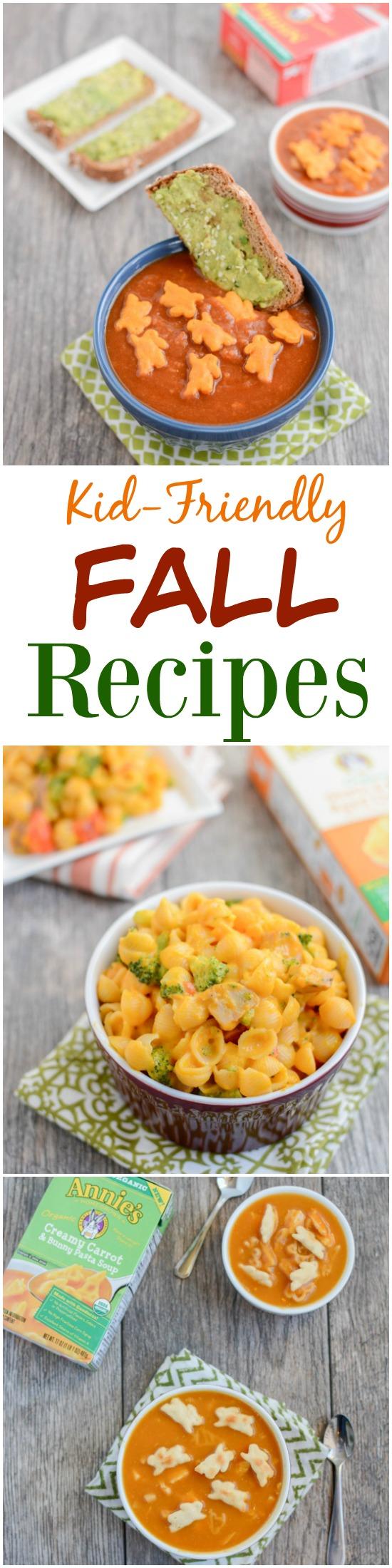
Packed full of vegetables, these kid-friendly recipes for fall use Annie’s products as a base to make three quick, wholesome lunch or dinner ideas the kids will love!


Packed full of vegetables, these kid-friendly recipes use Annie's products as a base to make three quick, wholesome lunch or dinner ideas the kids will love!

Thanks to Annie’s for sponsoring this post.


Hi Friends!


I’m not sure if I mentioned it or not but after Squish turned one a couple weeks ago, we went to the doctor for his checkup and she gave us the green light to transition him off formula. As you guys know, he’s been eating solid food since about 6 months, but until now formula has still been his main source of nutrients. Now that he’s eating all solid food, I’ve really been focusing on finding quick and easy meals he enjoys, that are also healthy!


About a month ago, he started spitting out some of the vegetables I give him, which I knew would happen at some point, so since then I’ve been experimenting with different ways to keep him eating those veggies!


Packed full of vegetables, these kid-friendly recipes use Annie's products as a base to make three quick, wholesome lunch or dinner ideas the kids will love!

When my friends at Annie’s reached out to me about trying some of their products, including a few of their new line of Organic Soups and some mac and cheese (my fav!), I jumped at the chance. They now offer five delicious soup flavors with fun, kid-friendly pasta shapes! I tried a few of the soups myself and really enjoyed them. However, as you might imagine, soup is a bit tough for my little guy to manage…especially since we’ve just started working on using a spoon. So, I put on my thinking cap and started thinking about ways that I could make the soup easier for him to eat. I chose two different soups and gave them a little nutrient boost, while simultaneously making them a little more toddler-friendly!


First up:


Packed full of vegetables, these kid-friendly recipes use Annie's products as a base to make three quick, wholesome lunch or dinner ideas the kids will love!

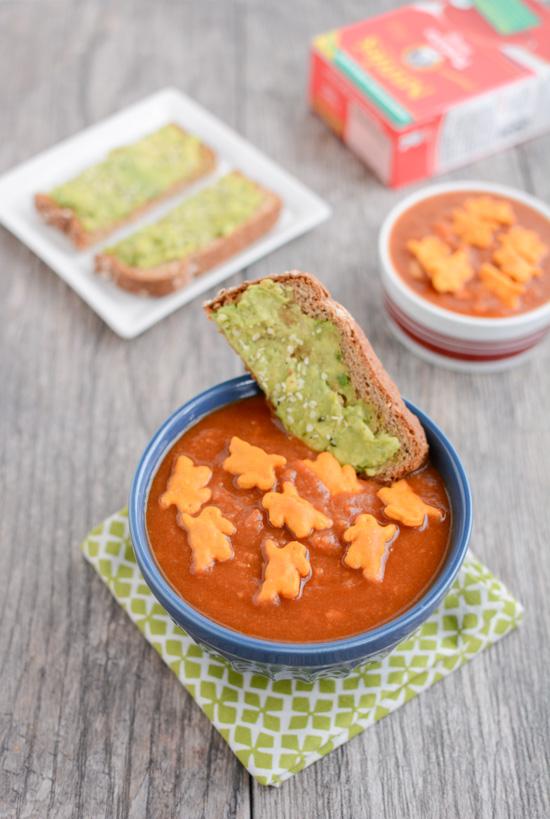
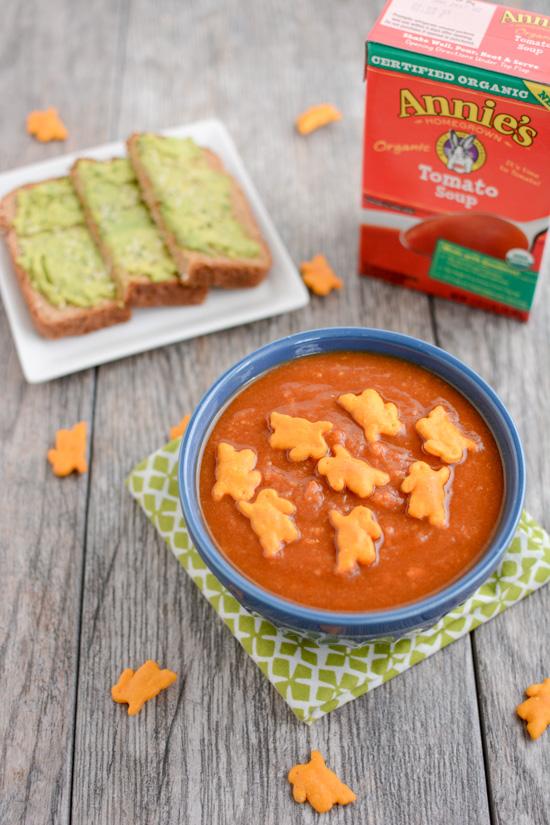
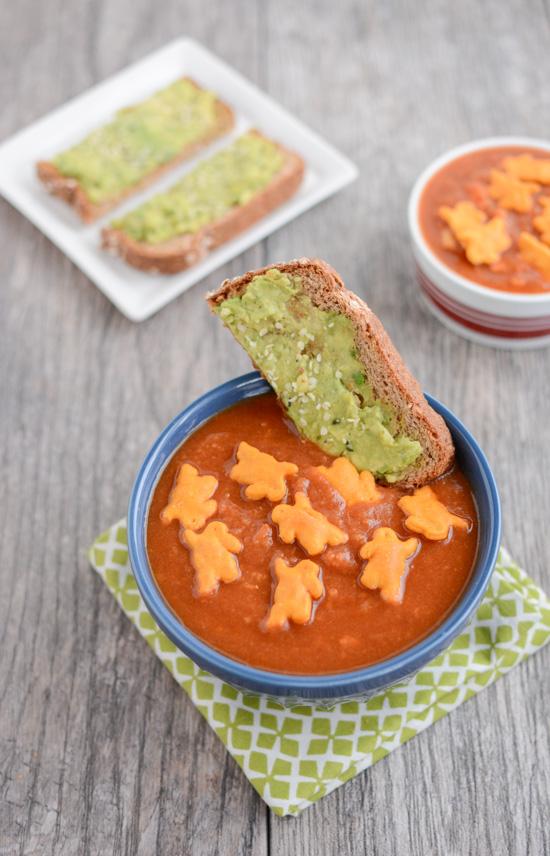
First of all, every serving of this soup packs in a 1/2 cup of vegetables, which is awesome. I knew I wanted to find a way to thicken the soup up a bit to make it easier for my toddler, so I grabbed a few of the sweet potatoes I baked during my weekly food prep, mashed them up and stirred them in. This is an easy way to add some beta-carotene to the meal. Our bodies convert beta-carotene into Vitamin A, which is important for good vision and also boosts our immune system – perfect timing since flu-season is here. Then, since kids love dipping things, I made some avocado toast dippers to go along with it. Added bonus – Vitamin A is a fat-soluble vitamin so it’s good to eat it with sources of healthy fat – ie avocado. I also sprinkled some hemp hearts on the toast for added texture.


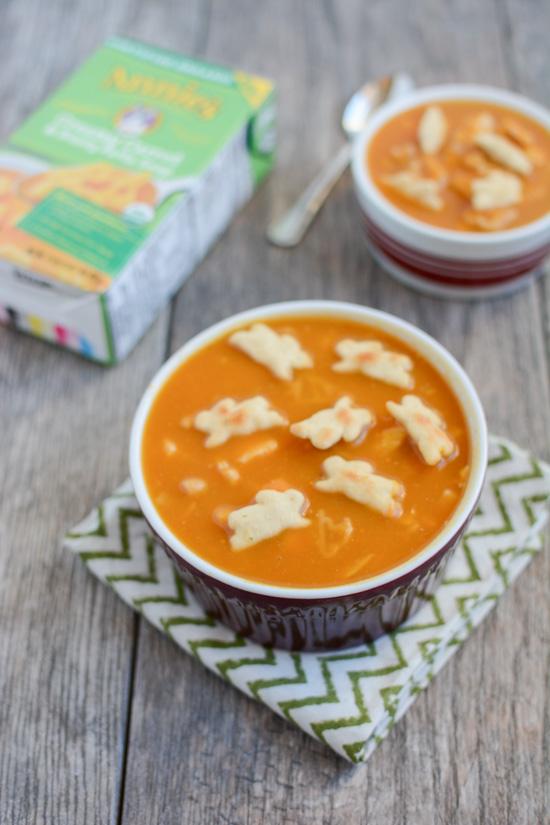
Then, to top everything off, I added some Cheddar bunnies….because they make fun little croutons! They soak up some of the tomato soup, which makes them nice and soft and Squish-friendly.


Packed full of vegetables, these kid-friendly recipes use Annie's products as a base to make three quick, wholesome lunch or dinner ideas the kids will love!

So let’s recap. To make this tomato soup you need:


  • 1 cup cooked, mashed sweet potato
  • Toast
  • Avocado
  • Hemp hearts

Directions:

Pour soup into large bowl. Add mashed sweet potato and mix well. Heat in the microwave or on the stove.

Mash avocado and spread on toast. Sprinkle with hemp hearts. Cut each piece of toast into dipping strips.

Ladle soup into bowls, top with cheddar bunnies and serve with a side of avocado dippers!


Up next –


Packed full of vegetables, these kid-friendly recipes use Annie's products as a base to make three quick, wholesome lunch or dinner ideas the kids will love!

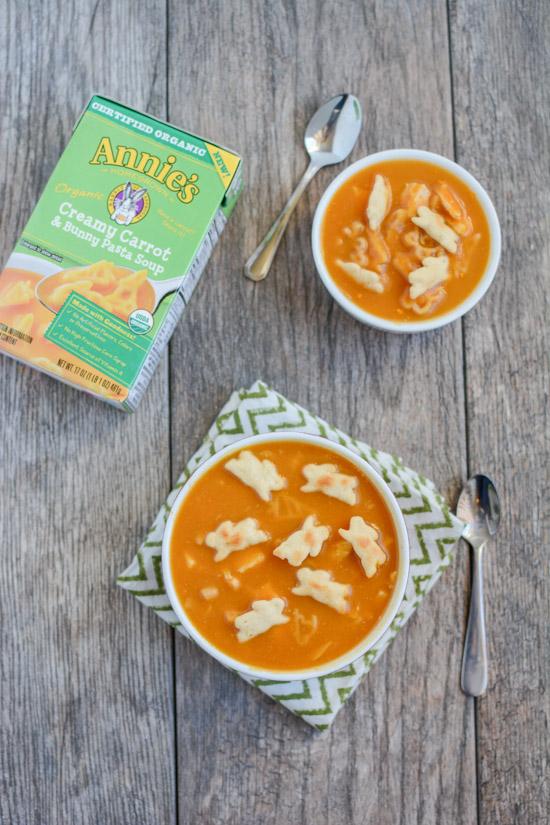
Squish is a pasta-lover like his mama, so I knew he’d love the pasta in this one. Although he’s probably not quite old enough to appreciate the fun shapes – bunnies and carrots – I thought they were so fun! Fun fact- a serving of this soup gives you 100% of your daily value of Vitamin A.


I recently did some baking with pumpkin, and as I’m sure you’ve experienced, I had a little bit of pumpkin left over. This soup has an orange color, very similar to pumpkin, so I decided to just mix that leftover pumpkin right in! Not noticeable in color or taste and another easy way to add some beta-carotene to your meal. I also threw in some leftover chicken from dinner earlier in the week for an added protein boost! Soups like this are one of my favorite kitchen shortcuts. They’re great on their own, but you can also use them as a base to transform your leftovers into a totally new meal!


Packed full of vegetables, these kid-friendly recipes use Annie's products as a base to make three quick, wholesome lunch or dinner ideas the kids will love!

To make this soup:


  • 1/3 – 1/2 cup pumpkin
  • 1 cup cooked chicken, chopped

Directions:

Combine all ingredients in a bowl and mix well. Heat and serve topped with bunnies!


And finally –


Packed full of vegetables, these kid-friendly recipes use Annie's products as a base to make three quick, wholesome lunch or dinner ideas the kids will love!

When I was pregnant with Squish, I pretty much lived on this mac and cheese. Either mac and cheese, Cheerios or peanut butter and jelly toast were just about all I could stomach for dinner for a several month stretch.


So it’s probably no surprise that mac and cheese is one of little man’s favorite foods as well. All Annies’s Mac and Cheese varieties are free of artificial flavors, synthetic colors and preservatives and I love pumping it up with some extra protein and veggies to make it a more complete meal. I make no exception when Squish eats it. I usually add some leftover chicken or some pre-cooked chicken sausage and then move on to the vegetables. Two of his favorite veggies are roasted squash and red peppers, so I mixed some of those right in and then I also added some broccoli, one of his least favorite veggies! Although he still picks some of it out, he’s much more likely to eat a few pieces if it’s covered in cheese and served with noodles.


Packed full of vegetables, these kid-friendly recipes use Annie's products as a base to make three quick, wholesome lunch or dinner ideas the kids will love!

To make the mac and cheese:


1 box of Annie’s Organic Shells & Real Aged Cheddar

3 Tbsp milk

1 cup chopped broccoli florets

1/2 cup roasted squashed, mashed (butternut or acorn work well)

1/4 cup roasted red peppers, diced

1-2 pre-cooked chicken sausages, chopped


Bring a pot of water to a boil. Add pasta and broccoli and cook for 8 minutes. Drain and return to pan. Mix in remaining ingredients (including cheese packet from mac and cheese) and stir until well combined. Serve warm.


So there you have it! 3 easy, kid-friendly meal ideas that are packed with fall veggies and still taste great!


Enjoy!

–Lindsay–


Original article and pictures take www.theleangreenbean.com site